Which casting or forging process is right for your parts? The complete comparison guide.
Technologies
30 October 2026
Read the article
Choosing the right casting or forging process directly impacts the quality, cost and lead time of your parts. Lost wax casting, resin-bonded sand casting, shell moulding, forging… each process has its own strengths, limitations and ideal applications.
At Castmetal Advanced Services, we master 10 casting and forging technologies, sourced through our qualified partner network in China.
This casting and forging process comparison gives you a clear vision to make the right decision or have a more informed discussion with our team.
Casting and forging process comparison
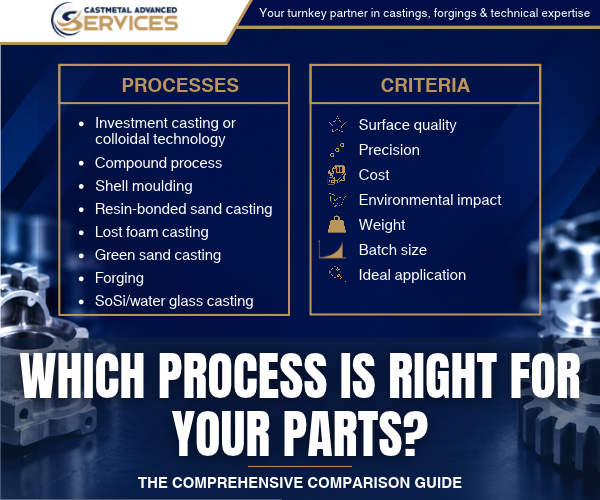
The table below compares the main casting and forging processes across five criteria: surface quality, dimensional precision, cost, environmental impact and ideal application.
Process
Surface quality
Precision
Cost
Environmental impact
Ideal for
Colloidal precision casting (lost wax)
Excellent
Excellent
Very high
Low
High-precision parts with fine details and complex geometries.
Compound process (lost wax)
Good
Very good
Moderate
Low
Complex parts progressively replacing SOSI and water glass, with better environmental impact, slightly higher precision and slightly higher cost.
Shell moulding or croning
Very good
Very good
Low
Moderate
Parts requiring high surface quality and thin walls with superior dimensional precision vs sand. Mainly for parts remaining in raw state.
Resin-bonded sand casting
Good
Good
Moderate
Moderate
Large parts in small to large series.
Lost foam casting
Very good
Good
Moderate
Moderate
Complex parts without parting lines or cores, integrating internal channels, very complex geometries and near net shape manufacturing.
Green sand casting
Fair
Fair
Very low
Low
Large parts in high volumes requiring low precision, in virtually all alloys. Dimensions up to several metres.
Forging
Very good
Good
Low
Very low
Parts requiring high mechanical strength in medium to very large series.
Water glass / SOSI (lost wax)
Good
Fair
Low
Moderate
Complex parts at competitive price requiring near net shape and complex internal geometries.
How to read this table?
No process is universally superior. The right choice depends on your specific requirements:
Surface quality refers to the regularity and smoothness of the finished part. Colloidal precision casting leads, followed by shell moulding.
Precision refers to dimensional accuracy and tolerance grades. Colloidal precision casting achieves the tightest tolerances.
Cost covers tooling, production and per-part cost. Green sand casting is the most economical.
Environmental impact considers waste, energy consumption and recyclability. Green sand casting and forging are more sustainable options. SOSI and water glass present a higher environmental impact and are progressively being replaced by the compound process, which offers better environmental performance while remaining competitive.
Ideal application is a starting point, not a rule. Many parts can be produced by several processes. The decision depends on volume, geometry, material and tolerance requirements.
Batch size & part weight: where does your part fit?
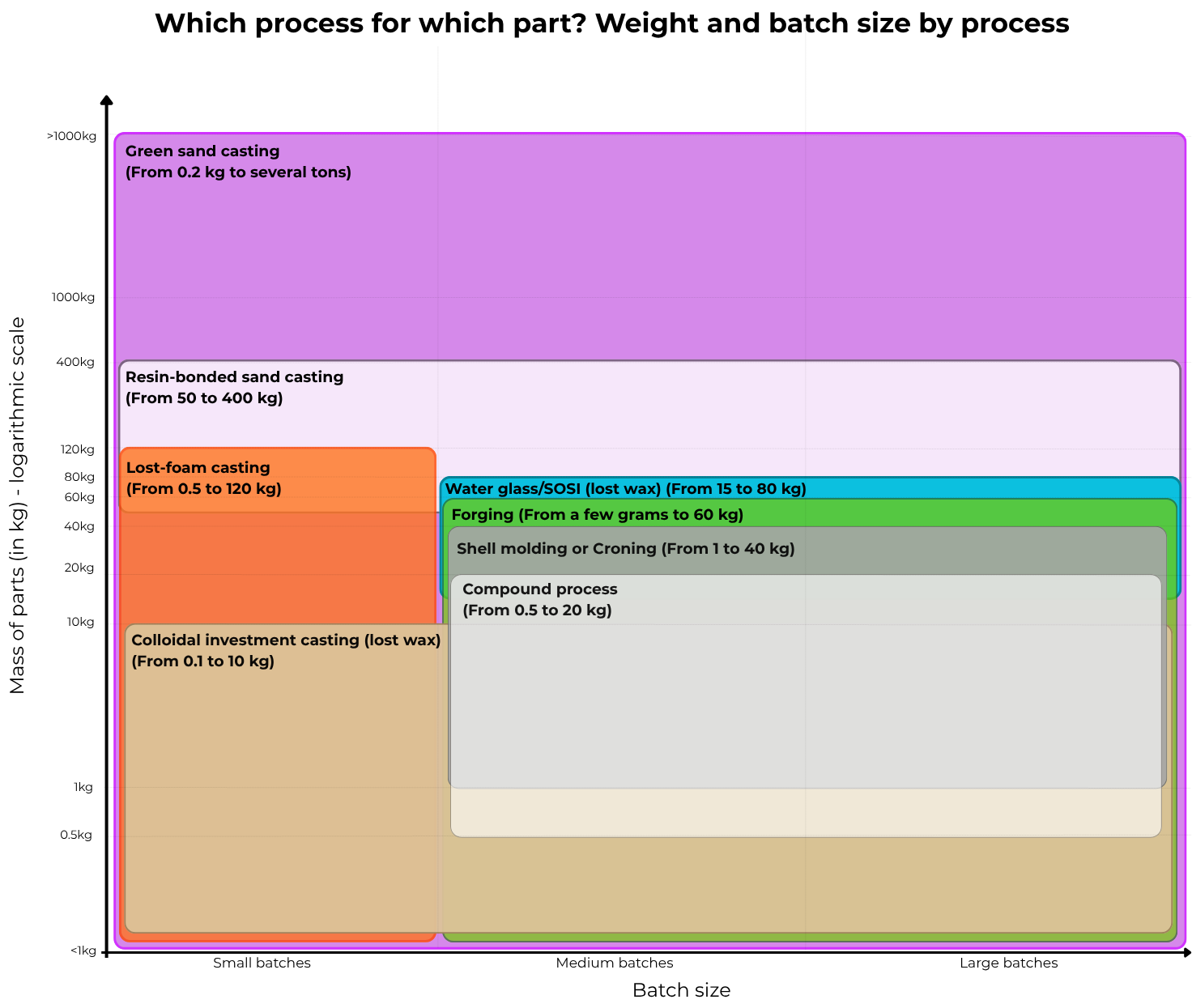
The chart below positions each process according to two complementary criteria: the weight of the parts produced and the batch size.
Green sand casting is the most versatile – from a few grams to several tonnes, in all batch sizes. At the other end, colloidal precision casting and the compound process are reserved for lighter parts.
In between, each process occupies a specific range, but weight and batch size are not the only criteria to consider. Surface quality, precision, cost and environmental impact seen in the table above also come into play to refine the choice.
Not sure which process fits your parts?
Our team evaluates your drawings, specifications and production volumes to recommend the most appropriate process from our network of audited partners in China.