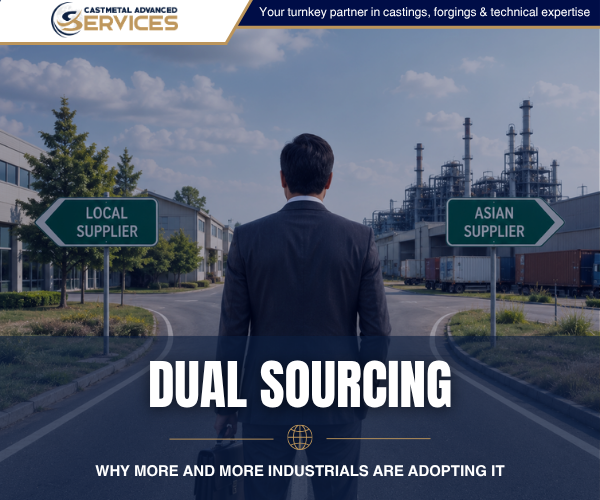
Dual sourcing, or double sourcing, means sourcing the same part or family of parts from two distinct suppliers. Long reserved for large groups, this model is now becoming increasingly common amongst industrial SMEs. In a context of geopolitical tensions, growing CSR obligations and permanent cost pressure, relying on a single supplier has become a risk in itself.
A context that is driving manufacturers to diversify
Global supply chains have been severely tested in recent years. The Covid crisis, tensions between the United States and China, logistical disruptions, and rising customs duties. As a result, according to McKinsey, by 2025, 39 per cent of manufacturers facing tariff impacts will have implemented dual-sourcing strategies for their components and raw materials.
The trend is clear. Buyers are no longer seeking only to optimise costs. They are seeking to build supply chains that are resilient, flexible and compliant with new regulatory and environmental requirements.
The two approaches to dual sourcing: local and international
Industrial dual sourcing is often based on the complementary nature of two distinct geographical regions, each with its own advantages. In practice, this complementarity most often involves a local supplier, a European one for our clients in Europe, and an Asian supplier. However, this model applies to any geographical combination: Turkey, Brazil, India or elsewhere.
A local supplier:
-
- Fast delivery and flexibility regarding volumes
-
- Cultural and linguistic proximity facilitating communication
-
- Compliance with standards and simplified traceability
-
- Compliance with the CSR requirements of certain customers
An Asian supplier:
-
- Competitive prices for large production runs, particularly thanks to reduced tooling costs
-
- A wide range of technologies, often available within a single supplier’s factory, including processes that are less easily available locally
-
- Large-scale production capacity
-
- The vast majority of global foundry production is based in Asia. It is a supplier network unrivalled on a global scale
The two approaches are not mutually exclusive. They complement each other. And it is precisely this complementarity that makes dual sourcing so valuable.
What dual sourcing actually achieves
Beyond simply reducing supplier risk, dual sourcing offers concrete strategic advantages:
-
- Securing production: dual sourcing allows you to have local production capacity available if needed.
-
- Managing market share: depending on the volumes ordered, it is possible to adjust the split between the two sources to optimise overall costs or meet cost and lead-time constraints.
-
- Maintaining competitiveness: regularly creating competition between the two suppliers maintains a level of competitiveness in the long term. In the event of a crisis (energy, raw materials, logistical disruptions), there are always ways to optimise between the two sources to absorb the impacts.
-
- Meeting customer requirements: some clients require two qualified suppliers for critical parts. Dual sourcing enables this requirement to be met with confidence.
Constraints that should not be underestimated
Dual sourcing is not a one-size-fits-all solution. It involves a number of prerequisites and constraints that every buyer must anticipate before proceeding.
-
- Minimum volume: each supplier must receive a sufficient volume to remain competitive and maintain their level of involvement with the part. Below a certain threshold, economies of scale are lost. No supplier will commit to a part if the volume is non-recurring or too low.
-
- Dual supplier qualification: qualifying two sources represents an investment in time, technical resources and travel costs. Audits, PPAPs and validations must be carried out twice.
-
- Traceability management: it is essential to distinguish between parts from each source, particularly for quality monitoring and the management of non-conformities.
-
- Double investment in tooling: if the part requires dedicated tooling, this will need to be produced for each supplier (including foundry tooling, machining tooling and inspection jigs where necessary).
-
- Complexity of coordination: two supplier relationships, two logistics flows, two quality standards. The administrative and management workload is significantly higher than with a single source.
-
- Dual quality monitoring: both suppliers require separate quality plans, audits and monitoring of non-conformities. The quality workload is doubled.
Castmetal Advanced Services, your partner for a dual-sourcing strategy
At Castmetal Advanced Services, we manage your entire Asian sourcing operation.
From co-developing the part to delivery to your production line, our team takes care of every stage: support from our European engineering team, supplier selection and qualification, production monitoring, on-site quality inspection, certification management, multimodal transport, customs clearance and storage where required.
You manage your European supplier. We take care of the rest, with a single point of contact and a permanent presence in China.
For high-volume orders, we can also set up dual sourcing directly in Asia, working with two qualified Chinese partners on the same component, to secure capacity or optimise delivery flexibility
Finally, for cast steel components, we can combine a qualified Chinese supplier with a European supplier provided by the Safe Metal Group’s foundries, to achieve a competitive and secure mix across both regions.
Contact us to discuss your sourcing strategy