When sourcing from Asia, the first thing that comes to mind is the price of parts. Rarely the transport journey that follows. Yet the choice of shipping mode has a direct impact on your lead times, cash flow, stock levels and total cost.
Sea freight, rail, air… each option has its strengths, constraints and risks. Here is what you need to know before choosing.
Sea freight: the reference for high volumes
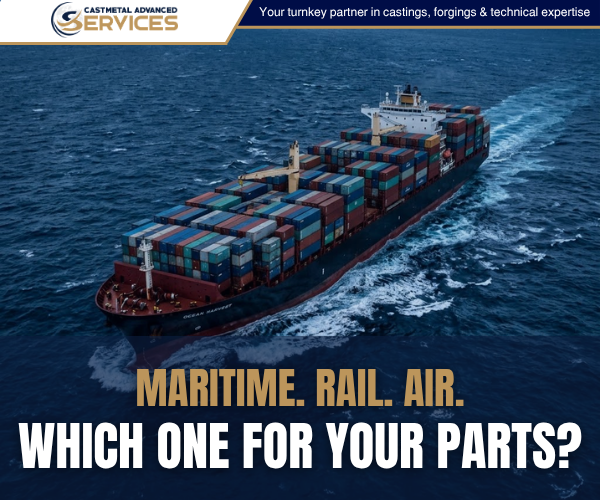
Sea freight remains the dominant mode for shipping industrial parts between Asia and Europe. It accounts for the vast majority of flows, for one simple reason: it is the cheapest per unit shipped for high volumes.
Port-to-port lead times between major Asian ports and European ports typically range from 30 to 45 days under normal conditions. Including factory loading, customs clearance and final delivery, the door-to-door lead time generally extends to between 40 and 55 days.
But these figures are benchmarks, not guarantees. Sea freight is subject to many disruptions:
- Geopolitical crises: the Red Sea crisis forced shipping companies to reroute via the Cape of Good Hope, adding 10 to 14 days per voyage.
- Weather events: extreme weather conditions – particularly typhoons in South-East Asia – can delay port calls and extend lead times.
- Equipment shortages: unavailable containers, capacity shortfalls in peak season, port strikes.
Sea freight is the competitive choice, provided you anticipate lead times and build in a safety margin in your planning.
Rail freight: the speed-cost compromise
Over the past decade, Asia-Europe rail freight has developed significantly. With lead times of 12 to 18 days compared to 30 to 40 days by sea, it meets the needs of companies shipping time-sensitive goods.
Rail transport remains significantly cheaper than air freight. This significant price difference makes it an attractive compromise for medium-value items.
But rail has its own risks:
- Geopolitical risks: the main route passes through Russia. International sanctions and geopolitical tensions can block or reroute flows overnight.
- Gauge changes: at the China-Kazakhstan border, trains must change bogies due to a different track gauge – an operation that takes 24 to 36 hours.
- Limited capacity: rail cannot absorb the same volumes as sea freight.
- Accessibility: not all European destinations are directly served. A last-mile road leg is often required.
Rail is a relevant option for urgent replenishments or high-value parts, without going as far as the cost of air freight.
Air freight: speed at any cost
Air freight between Asia and Europe typically takes between 5 and 10 days for standard air, less than a week for express. It is the fastest mode, but also the most expensive, with rates significantly higher than sea or rail.
Note: standard air freight is billed from a minimum of 100kg. Express offers finer weight brackets, allowing better cost optimisation for small volumes, but customs handling is less predictable.
For industrial parts, air freight is used in specific cases:
- Sending the PPAP (first article inspection sample) before serial production launch
- Managing a critical stock-out
- Urgent spare parts for a stopped production line
- Small quantities of high-value parts
For significant volumes of cast or forged parts, air freight is not economically viable. It remains a last-resort or launch tool.
Multimodal transport: optimising based on context
In practice, the right logistics decision is rarely binary. Multimodal transport, combining sea, rail, air and road depending on the segment, allows you to optimise both lead time and cost based on context.
A sea container for serial volumes. Rail for urgent replenishments. Air for PPAPs and emergencies. Road for the last mile to your site.
Choosing the right routing goes far beyond comparing lead times on a rate sheet. It requires monitoring geopolitical developments, port congestion, available capacity and the specific risks of each corridor. And before even choosing the transport mode, it is essential to master incoterms – those three letters that define who pays what and who bears the risk at each stage.
Discover our comprehensive guide about Incoterms:
→ Incoterms: why three letters can cost you a lot in industrial sourcing
This is a full-time job, and it is exactly what our logistics teams do.
Last mile and buffer stock
Delivery to the European port is only the first part of the journey. Once arrived, your parts still need to be cleared through customs, transported to your warehouse and integrated into your production line. This final segment, often underestimated, can also generate delays.
To absorb the disruptions of international transport and avoid any production stoppage, we offer our clients a secure storage option in France. In practice, this reduces delivery lead times from several months from Asia to just a few weeks from our stock – with processing at Le Havre typically taking 10 days, for a client delivery within 2 to 3 weeks maximum.
This buffer stock allows you to:
- Smooth out delivery irregularities linked to maritime disruptions
- Respond to unexpected demand peaks
- Reduce the stock level required at your end
- Secure ramp-up phases – between PPAP, first series and second series lead times, buffer stock prevents any stoppage during the production ramp-up
Castmetal Advanced Services manages your logistics end to end
Transport mode selection, route management, container tracking, customs clearance, last mile – we manage this entire chain on your behalf. Our teams track your parts at every stage, from the supplier’s factory to your production line, and adapt logistics decisions in real time.
Want to optimise your Asia-Europe logistics?
Our team selects the most appropriate transport mode for your lead time, cost and risk constraints and manages the entire chain on your behalf.
Contact us